Extra Credit Event 1: Gattaca Watch Party
For this event, I went to the Gattaca watch party. This movie represented the topic of biotechnology and how it can impact the world. In this movie, the genetic engineering of humans is common. Those who are created with genetic engineering technology are considered superior, and are called "valids". Others who are conceived naturally are considered inferior, and are called "invalids". The difference between valids and invalids is shown through characters Anton and Vincent. Vincent is born first, naturally, and when he is born his DNA is sequenced. He has a high probability of multiple diseases and a shorter lifespan. His brother, Anton, is born using genetic selection, and the geneticist eliminates the risk of diseases in the child and selects for certain characteristics. Anton is considered valid and genetically superior. This scene, shown below, reminded me of the concept of "designer babies". Last quarter, I took MCDB 50 which discussed stem cell ethics. We learned about "designer babies", where parents can basically design how their baby will be. These babies are conceived using in vitro fertilization (IVF), where a baby can be genetically engineered for a variety of different traits. For example, the gender can be selected and the risk for diseases can be lowered.
This practice is not as uncommon as you would expect. For example, in 1996, parents Monique and Scott Collins used IVF to select for a female embryo. They went to the Genetics & IVF Institute in Fairfax, Virginia. People have also used IVF to select against different genetic diseases. Preimplantation genetic diagnosis (PGD) allows embryos to be screened for certain genetic diseases, before they are implanted in the mother. They can select for embryos that are at less risk for genetic conditions.
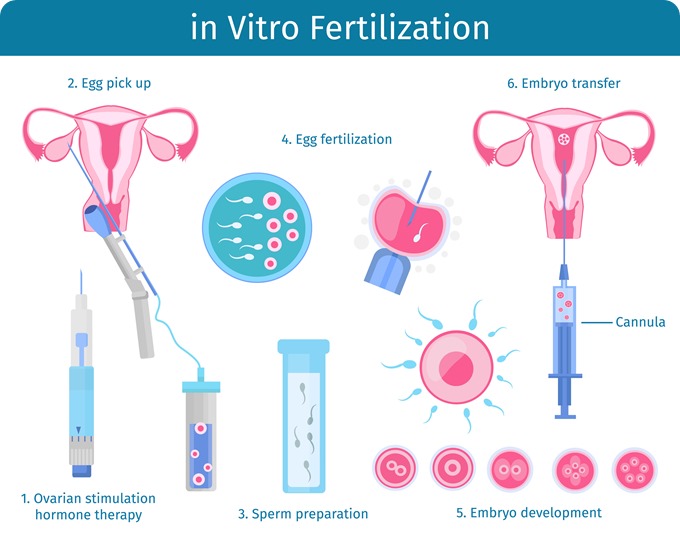 |
| IVF diagram |
This new practice brings about many different ethical questions. Should we be allowed to genetically select traits in babies? Some argue that we should be allowed to, because it can prevent genetically inherited diseases and it can make society more technologically advanced. Others argue that people would take it too far and would select for traits that are more cosmetic. Personally, I think that the genetic engineering of embryos should be allowed in certain situation, such as diseases prevention, but should be highly regulated. It should not be used for cosmetic purposes or to select for certain characteristics. I also think that if it is used for disease prevention it should be accessible to everyone, as there are already enough healthcare disparities in today's society. I think that it needs to be regulated, because it could be taken too far. I think that selecting for certain traits, like hair color or eye color, is unethical and should not be allowed. I also think that diversity and human differences should be valued and appreciated, and selecting for certain traits could erase some human diversity.
 |
| "Designer baby" |
In Gattaca, another thing that stuck out to we was the stark difference in treatment between those who were "valid" and considered genetically superior and those who were "invalid" and considered genetically inferior. For example, those who are "valid" are hired more for jobs. They test DNA during the hiring process, and only hire those who have a "good" genome. Those who are genetically engineered live much better lives than those who are not. The movie also showed how they have genetic "checkpoints" everywhere. Everywhere you go people check your DNA, for example Irene, a main character even checked Vincent's DNA before going on a date with him. I think that this portrayed many people's fear of the use of biotechnology. I think the inequity between those who are genetically engineered and those who are not, is unethical and unacceptable. I definitely think there needs to be strict regulation on embryo engineering to make sure the powerful technology doesn't get abused.
 |
| Gattaca Genetic Checkpoints |
I would definitely recommend this movie to others. I really enjoyed it, and it was really suspenseful. I liked how it addressed ethical questions and had an interesting plot.
Sources:
“Designer Babies: an Ethical Horror Waiting to Happen?” The Guardian, Guardian News and Media, 8 Jan. 2017, www.theguardian.com/science/2017/jan/08/designer-babies-ethical-horror-waiting-to-happen.
“Designer Babies: the Arguments for and Against.” The Week UK, The Week, 17 July 2018, www.theweek.co.uk/95108/designer-babies-the-arguments-for-and-against.
“Gattaca Visit to the Local Geneticist.” YouTube, YouTube, 17 June 2009, www.youtube.com/watch?v=lP1cCjBkWZU.
“Genetic Ethics 101.” Bioethics.com, 20 July 2016, bioethics.com/genetic-ethics-101.
“Preimplantation Genetic Diagnosis (PGD).” What Is PGD?, www.givf.com/geneticservices/whatispgd.shtml.
Riding, James. “Debate Rages as First Designer Babies Born.” The Day, theday.co.uk/stories/debate-rages-as-first-designer-babies-born.
“The Embryo Project Encyclopedia.” Ethics of Designer Babies | The Embryo Project Encyclopedia, embryo.asu.edu/pages/ethics-designer-babies.
Thomas, Dr. Liji. “Stages of IVF.” News, 26 Feb. 2019, www.news-medical.net/health/Stages-of-IVF.aspx.


Comments
Post a Comment