Week 7: Neuroscience and Art
This week's topic was really interesting to me. Neuroscience and art have lots of intersections and it was interesting to learn about them. Art and neuroscience have been connected for centuries. Early scientists and doctors used to draw parts of the brain as they researched it. An example of this is Spanish Neuroscientist, Santiago Ramon y Cajal. Santiago Ramon y Cayal researched brain tissue and drew what he observed. These drawing helped other researchers visualize the brain later on, and he won a Nobel Prize for these drawings in 1906. This stood out to me, because even 100s of years ago scientists have incorporated art into their research. As someone who is mostly interested in science, I never thought about how neuroscience intersected with art. I always thought that people were either good at one or the other. However, I was quite wrong. Artists like Santiago Ramon y Cajal show how people can be masters of both science and art and can use both fields to create amazing things.
 |
| Santiago Ramon y Cajal work drawing brain tissue |
 |
| fMRI used to view brain activity |
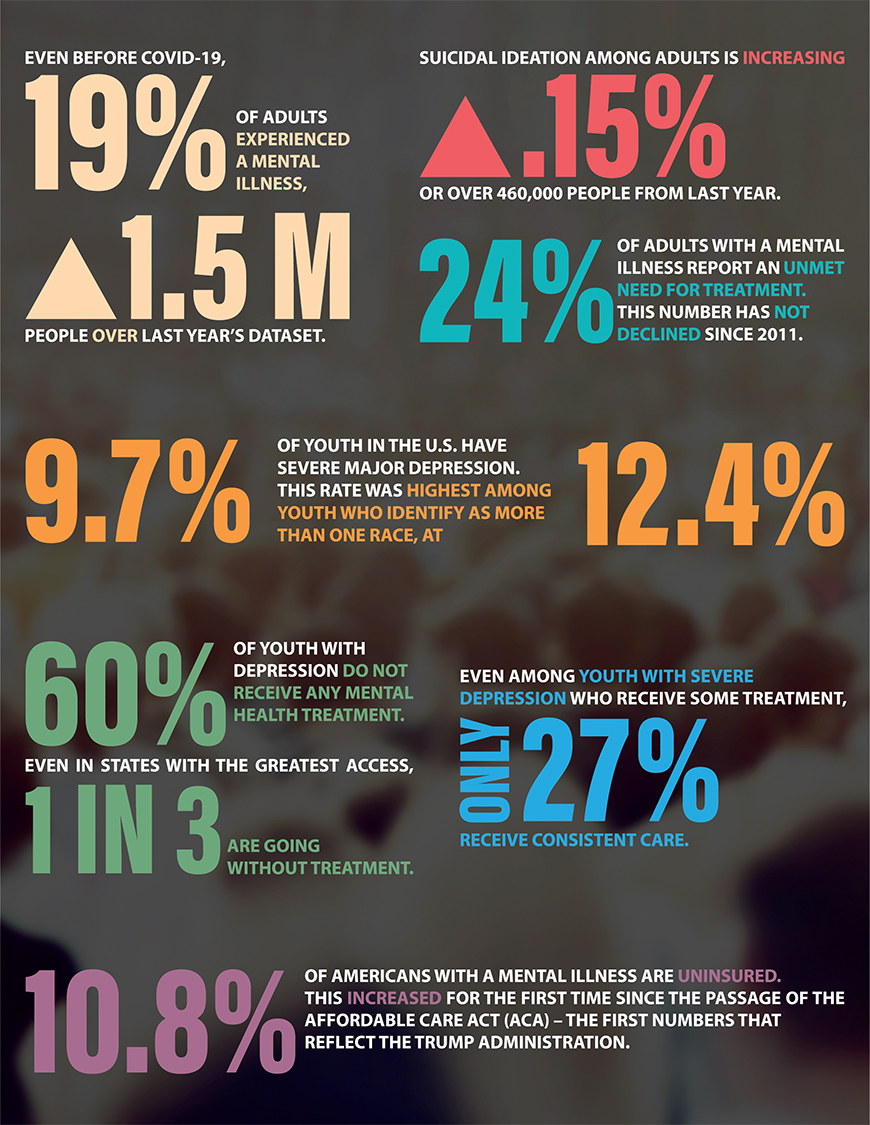 |
| Many people are affected by mental health issues, but art may be a way to help cope with them. Sources: American Art Therapy Association, arttherapy.org/. deCharms, Christopher. “A Look inside the Brain in Real Time.” TED, www.ted.com/talks/christopher_decharms_a_look_inside_the_brain_in_real_time#t-65436. “The Interplay between Neuroscience and Art.” Organization for Human Brain Mapping, www.ohbmbrainmappingblog.com/blog/the-interplay-between-neuroscience-and-art. Leman, Jennifer. “The Brain in Images: Top Entries in the Art of Neuroscience.” Scientific American, Scientific American, 29 July 2019, www.scientificamerican.com/article/the-brain-in-images-top-entries-in-the-art-of-neuroscience1/. Montañez, Amanda. “Ramón y Cajal and the Case for Drawing in Science.” Scientific American Blog Network, Scientific American, 23 June 2015, blogs.scientificamerican.com/sa-visual/ramon-y-cajal-and-the-case-for-drawing-in-science2/. Nelson, Roger. “Global Consciousness Project: Introduction.” Princeton University, The Trustees of Princeton University, noosphere.princeton.edu/gcpintro.html. Phillips, Renee. “Art Enhances Brain Function and Well-Being.” The Healing Power of ART ARTISTS, www.healing-power-of-art.org/art-and-the-brain/. |
“The State of Mental Health in America.” Mental Health America, mhanational.org/issues/state-mental-health-america.


I liked your discussion on how neuroscience and art relate to mental health. It's a very prominent issue in today's society, so I think it is very important that we understand what contributes to mental illness and look for ways to relieve it. Art therapy is something that should be publicized more because it has incredibly positive benefits and is not hard to get access to.
ReplyDeleteI also watched Christopher deCharms's TED Talk. I was shocked to realize that it would be possible to alter signals such as pain just by watching the scan in real time. It didn't cross my mind that it would also be possible for people to abuse it as well. It's a new and interesting concept, so there definitely needs to be regulations to prevent negative side effects or abuse. Good job on your blog!
ReplyDelete